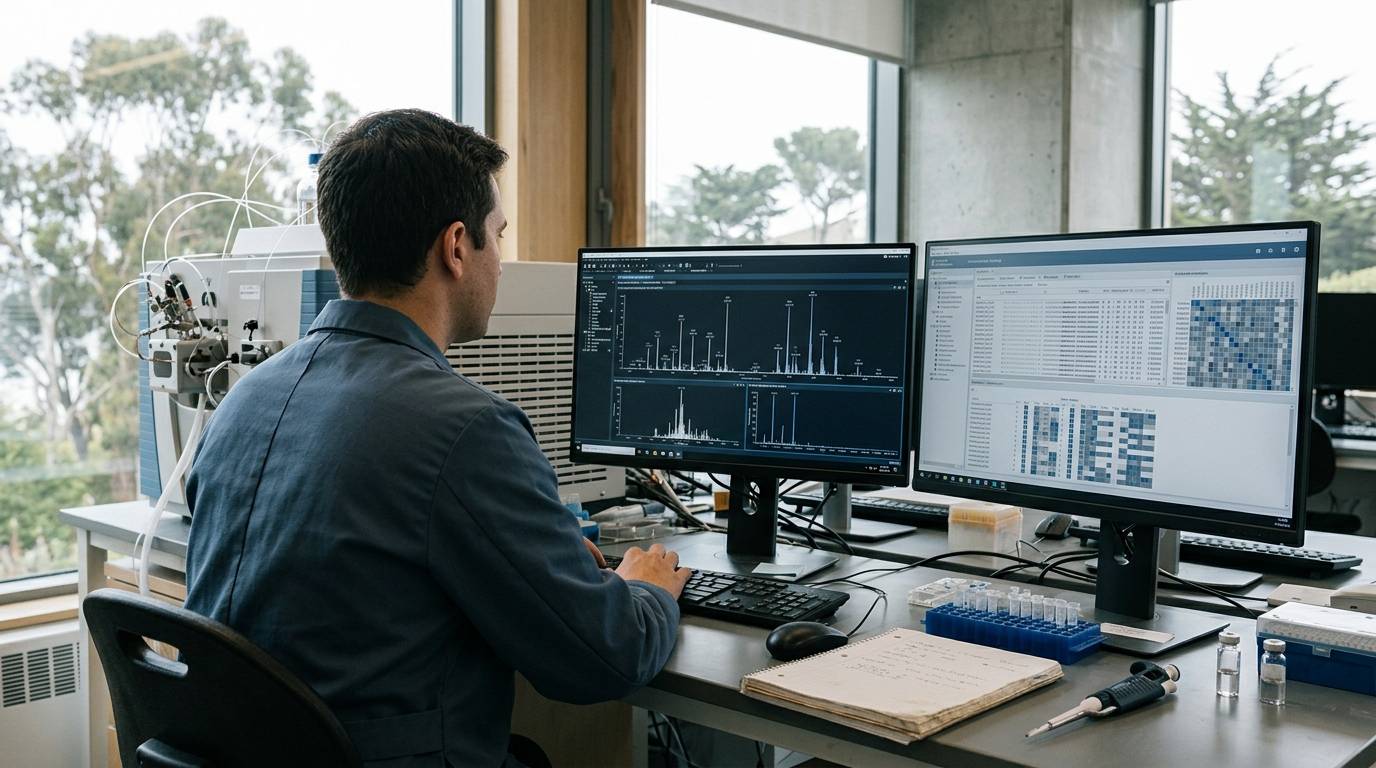
Researchers in an original in vitro purification study tested a 23-peptide model library spanning specifically designed impurity types. This laboratory investigation demonstrated that related molecular species often possess identical or near-identical masses. Understanding these structural similarities explains why relying on a single mass measurement fails to capture a complete analytical profile.
Can mass spectrometry alone distinguish all peptide impurities?
Mass spectrometry alone is fundamentally insufficient for comprehensive purity assessment without adequate chromatographic resolution because various impurities share identical or near-identical masses with the target peptide.
Tandem Mass Spectrometry Separates Temporal and Structural Data
Liquid chromatography provides essential temporal separation for detectable components over time before molecular analysis begins. As these specific peptide components elute from the liquid chromatography column, they undergo ionization for introduction into the instrument. An initial scan measures the intact ions to establish the precise mass-to-charge ratios for the introduced molecules. The scientific literature refers to this critical intact peptide measurement as the MS1 scan.
Tandem mass spectrometry builds upon this foundation by selecting specific precursor ions for further structural analysis. The analytical instrument isolates and fragments these specific precursor ions to generate detailed structural information. This targeted fragmentation process produces distinct product-ion patterns that can confidently support accurate sequence assignment. Analyzing these unique fragment spectra helps laboratory professionals practice evaluating analytical testing claims effectively.
During sequence identification, the measured precursor mass is considered alongside the resulting fragment ions. Database workflows systematically compare the experimentally observed tandem mass spectra with established theoretical spectra. These theoretical records are generated in silico from a user-specified sequence database to guide the matching process. A scientific review notes that matching against defined databases allows researchers to connect published claims to actual study designs reliably.
Modification Placements Create Identical Mass Profiles
A published review of protein modifications indicates that distinct molecular modifications can be isobaric or nearly isobaric. For example, phosphorylation and sulfonation present nearly identical masses during standard analytical testing. The same review clarifies that a single modification can occur at different amino acid positions on a peptide chain. This specific positional variation yields isomeric species while retaining the exact same overall mass of the original compound.
Either scenario presents a high risk of modification misassignment during standard laboratory analysis. When structurally distinct molecules present the same molecular weight, simple mass measurements cannot differentiate them effectively. Researchers must deploy robust separation techniques to distinguish target peptides from nearly identical impurities confidently. The scientific consensus maintains that adequate resolution remains absolutely necessary to prevent critical analytical errors.
Synthetic Libraries Model Common Impurity Patterns
In an original synthetic-peptide purification study, investigators utilized a carefully constructed in vitro model to evaluate separation methodologies. The resulting library comprised 23 specific peptides designed to represent plausible synthesis-related impurities. This comprehensive laboratory model included five primary target peptides alongside deliberately synthesized structurally related species. The researchers classified these synthesized molecules into seven distinct impurity groups based on their structural characteristics.
These seven groups reflected common impurity patterns encountered during typical peptide synthesis protocols. The in vitro laboratory model included deamidation variants, leucine and isoleucine isomers, isoaspartate formation, and specific deletion products. It also contained grouped combinations of terminally acetylated and nonacetylated forms for a thorough analytical evaluation. By mapping these specific variants, researchers created a clear foundation for building an evidence map for peptide research.
Identity Confirmation Requires Different Methods Than Purity
The synthetic-library study authors explicitly reported that related impurities could share or closely approach the target molecule's mass. The researchers highlighted that isoaspartate variants and deamidated forms frequently present this exact analytical challenge. They concluded that mass spectrometry alone was fundamentally insufficient for purity assessment without adequate chromatographic resolution. This firm conclusion emphasizes that simply measuring a molecular weight does not inherently prove a compound is completely pure.
To address these limitations, the researchers applied different analytical methods for distinct laboratory characterization goals. The investigators employed a dedicated liquid chromatography and mass spectrometry method exclusively for compound identity confirmation. However, they determined the initial peptide purities by utilizing liquid chromatography coupled directly with ultraviolet detection. The study authors emphasized that robust chromatographic resolution mattered precisely because these related species shared near-identical mass profiles.
Returning to the 23-peptide model library illustrates that confirming a molecular mass is merely the first step in compound characterization.
While tandem mass spectrometry provides robust sequence evidence, current scientific consensus indicates that distinguishing structurally related isomers fundamentally requires adequate chromatographic resolution.
How CaliLean helps
Interpreting analytical data requires distinguishing sequence identification from compound purity. CaliLean supports this process by pairing research materials with clear scientific education and transparent laboratory documentation. We resolve unclear distinctions between cell, animal and human research. A researcher or technically literate investigator can access these traceable sources for reliable peptide information without exaggerated claims. Explore the Research Library
Sources
Introducing / CaliLean Field Notes
A little more
perspective.
An editorial letter for curious minds. Thoughtful reading, questions worth keeping and the sources behind them.
Explore Field Notes Join the list for the first edition