

A certificate of analysis becomes more useful when each result stays attached to its sample, method and reporting language. The large percentage is one part of that record. The identifying fields, separate quantity measurements and laboratory's scope statement deserve the same attention.
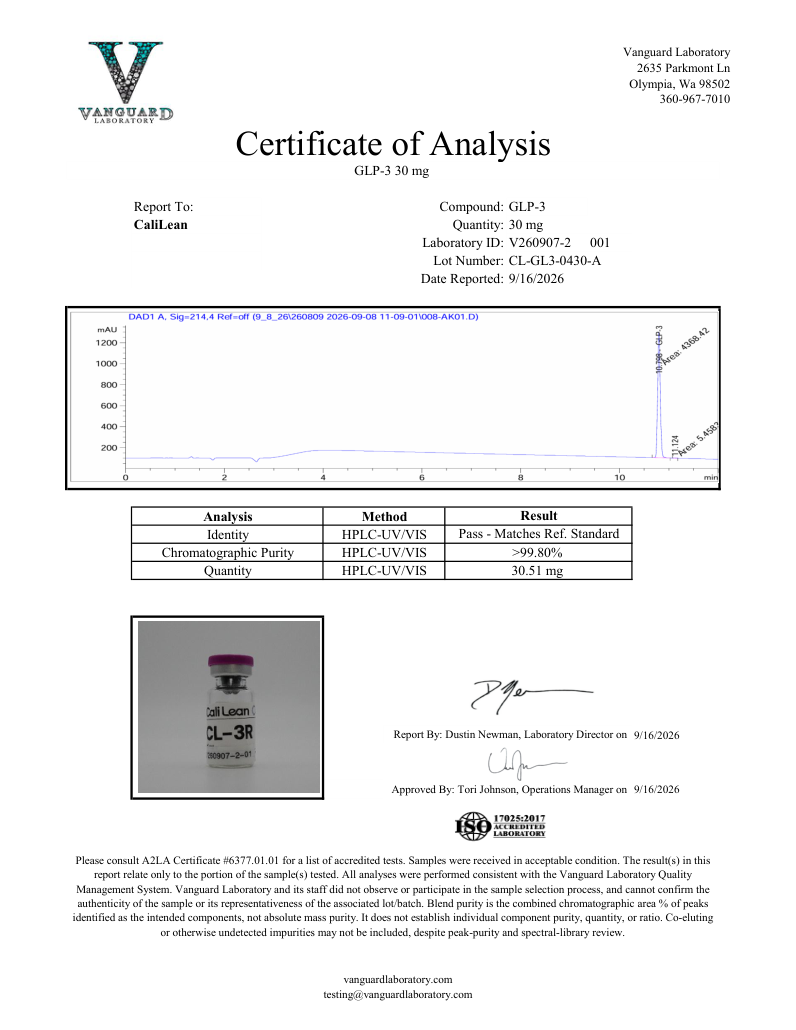
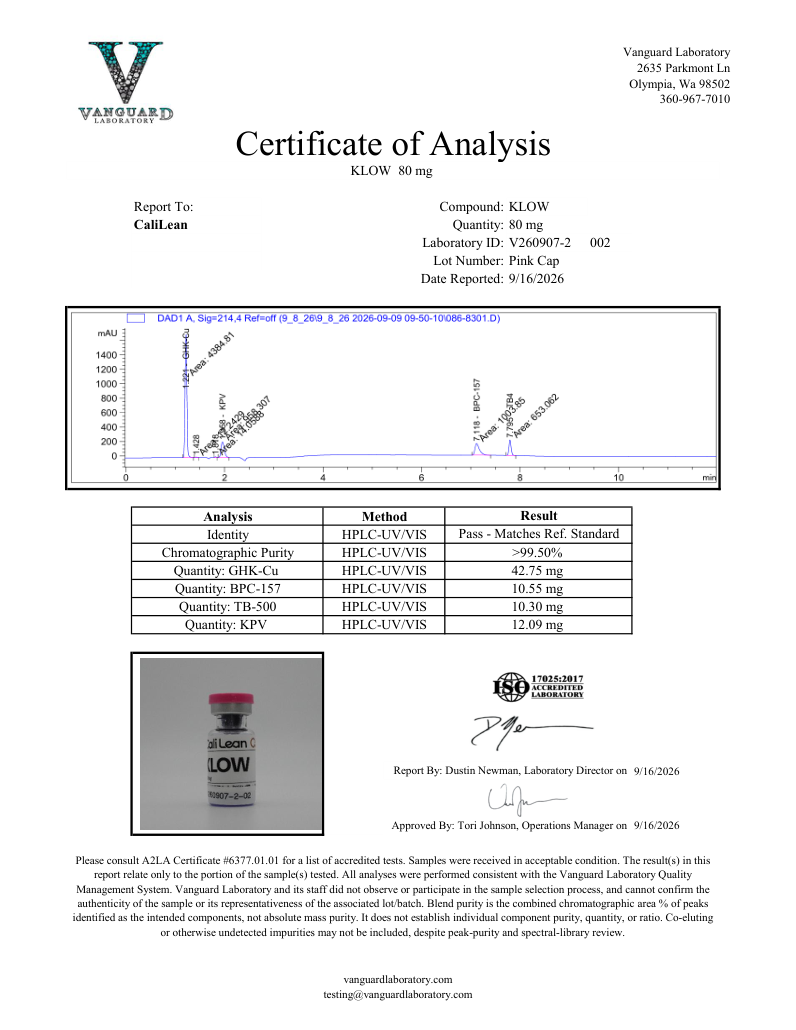
This guide works through two original Vanguard Laboratory certificates supplied to CaliLean: GLP-3 30 mg, laboratory ID V260907-2 001, and KLOW 80 mg, laboratory ID V260907-2 002. Both are dated September 16, 2026. Their reported findings concern the submitted portions tested. Read the complete GLP-3 certificate and KLOW certificate alongside this explanation.
Begin with the document's identity
Before interpreting a result, establish which document you have open. Record the issuing laboratory, laboratory ID, reported date, compound name and lot entry. These fields provide a way to ask a precise follow-up question or compare a report against other documentation.
The two certificates illustrate why exact transcription matters:
| Document field | GLP-3 report | KLOW report |
|---|---|---|
| Laboratory ID | V260907-2 001 | V260907-2 002 |
| Compound entry | GLP-3 | KLOW |
| Stated quantity in header | 30 mg | 80 mg |
| Lot number entry | CL-GL3-0430-A | Pink Cap |
| Date reported | September 16, 2026 | September 16, 2026 |
These entries are transcribed from the two original certificates. The KLOW lot field is a descriptive entry. Preserve it as written when discussing the report; do not replace it with an invented batch code. A future report with a different identifier needs its own record even if the compound name looks familiar.
The GLP-3 certificate also includes a submitted-vial photograph bearing a CL-3R label. The report's compound field remains GLP-3. That visible naming difference should be retained in the record and clarified before using this certificate to support a current CL-3R listing. The photograph alone does not establish equivalence across products or later shipments. Original GLP-3 certificate, header and vial photograph.
Read the analysis rows separately
Both reports organize their results under three useful ideas: identity, chromatographic purity and quantity. Read each row with its own method and result, preserving the wording and units.
In the GLP-3 report, the identity entry records a match to the reference standard, the chromatographic purity entry is greater than 99.80%, and the quantity entry is 30.51 mg. All three list HPLC-UV/VIS as the method. The header's 30 mg entry and the measured 30.51 mg result occupy different places in the document; your reading note should preserve both. Original GLP-3 results table.
The KLOW report gives an identity match, chromatographic purity greater than 99.50%, and four separately named quantity results. It does not present the 80 mg header as the outcome of those four rows. Original KLOW results table.
| KLOW quantity row | Reported measurement |
|---|---|
| GHK-Cu | 42.75 mg |
| BPC-157 | 10.55 mg |
| TB-500 | 10.30 mg |
| KPV | 12.09 mg |
Keep the component names beside these numbers when taking notes. Copying a single percentage or the header amount would omit information the laboratory chose to report separately. The table above reproduces the quantity rows, with no inferred target ratios or added acceptance criteria. Original KLOW certificate.
Keep the percentage's definition attached
The greater-than sign matters. The reported values are >99.80% and >99.50%. Rounding them into an unqualified claim of 100% would change the statements in the source.
The footer gives an additional limit for blends: its purity figure describes the combined chromatographic area associated with the intended components. It does not establish the absolute mass purity, individual component purity, quantity or ratio. The footer also notes that co-eluting or otherwise undetected impurities may fall outside what is included. These qualifications belong with any summary of the blend result. Vanguard scope statement on the KLOW certificate.
For a practical reading note, use the full name chromatographic purity. Keep the separate component measurements in their own column. That wording lets another reader see which reported question each value addresses without needing to reconstruct your assumptions.
Use the chromatogram as part of the record
The plotted trace is worth inspecting alongside the results table. Start by finding the axes, printed labels and connection to the report ID. The GLP-3 and KLOW documents contain visibly different traces and component annotations. This guide does not recalculate the laboratory's integrations or independently identify the peaks from the image.
Chromatography separates components through their behavior between a moving phase and a stationary phase. That is the underlying separation concept described by IUPAC's chromatography definition. Interpreting a particular trace requires the accompanying analytical context; a visually prominent peak does not supply all the information behind the reported measurement.
If you need to understand how a value was obtained, ask which method documentation, reference information and supporting data are available for that report. FDA's ICH Q2(R2) guidance provides a broader framework for analytical procedure validation. It is background reading here, rather than a certification that these particular samples or reports satisfy a regulatory requirement.
Read the scope statement before extending the result
Vanguard states that its results relate to the portion tested. It also states that the laboratory did not observe or participate in sample selection and cannot confirm the sample's authenticity or its representativeness of the associated lot or batch. These are material limits on what the supplied certificates establish. Scope statements in the GLP-3 and KLOW certificates.
The reading consequence is specific: a certificate can document the laboratory's reported findings for the submitted portion while leaving a broader sampling question unresolved. The existence of a lot entry does not remove that qualification. A later shipment or another vial needs appropriate supporting documentation before the earlier result is extended to it.
The displayed analysis tables also contain no reported sterility or endotoxin test results. Their omission is a boundary of these documents, not a finding that either attribute passed or failed. A reader who needs another attribute assessed should look for the relevant test record and its stated scope. Original analysis tables.
Notice what is available and what needs a question
A report can be useful while leaving questions for the laboratory or material supplier. Mark those questions explicitly. For these certificates, useful follow-ups include the link between the submitted sample and the current material, the meaning of a descriptive lot entry, and which additional method or measurement documentation can be supplied.
For quantitative work, a reported number and its measurement context should travel together. NIST explains that metrological traceability concerns a measurement result's documented connection to a reference, including uncertainty along that chain. An instrument name or a laboratory logo alone does not establish that connection. This is a reason to ask for appropriate supporting information when a research decision depends on it; this guide does not make a NIST-traceability claim for either certificate. NIST's traceability guidance.
Avoid filling unanswered fields with assumptions. A note that says “supporting record requested” is more useful than an unsupported conclusion disguised as a complete checklist.
Make a reading note you can revisit
Keep a small record with the original PDF rather than saving only a cropped results image:
- Document: laboratory, ID, reported date and file location.
- Sample: exact compound and lot entries, plus any naming discrepancy.
- Results: each reported value, unit, method and qualifier.
- Scope: the portion tested and the laboratory's sampling limitations.
- Open questions: missing context, requested records and who can clarify them.
- Your conclusion: one sentence restricted to what the document supports.
For example: “Vanguard report V260907-2 001 records an identity match, >99.80% chromatographic purity and 30.51 mg for the submitted GLP-3 portion, with the sampling limitations printed in the certificate.” This is a document summary, not a product recommendation or a statement about all material bearing a similar name.
Continue with the laboratory report library, the analytical methods introduction or how to read a research paper. A COA and a research publication answer different questions, and each benefits from keeping its original source close.
Sources and editorial preparation
Prepared October 3, 2026 with AI assistance. Report fields were checked against the supplied original certificate images; external explanatory statements were checked against the linked institutional sources. This is an educational editorial guide and does not carry an independent laboratory verification or external expert-review claim. Corrections can be sent through Contact.
- Vanguard Laboratory. GLP-3 30 mg, V260907-2 001, reported September 16, 2026.
- Vanguard Laboratory. KLOW 80 mg, V260907-2 002, reported September 16, 2026.
- IUPAC. Chromatography, Gold Book entry C01075.
- FDA. Q2(R2) Validation of Analytical Procedures, March 2024.
- NIST. Metrological Traceability: Frequently Asked Questions and NIST Policy.
All CaliLean materials are for in-vitro and laboratory research only, not for human or animal consumption. This guide provides no medical advice, dosing guidance or administration protocols.
Introducing / CaliLean Field Notes
A little more
perspective.
An editorial letter for curious minds. Thoughtful reading, questions worth keeping and the sources behind them.
Explore Field Notes Join the list for the first edition

