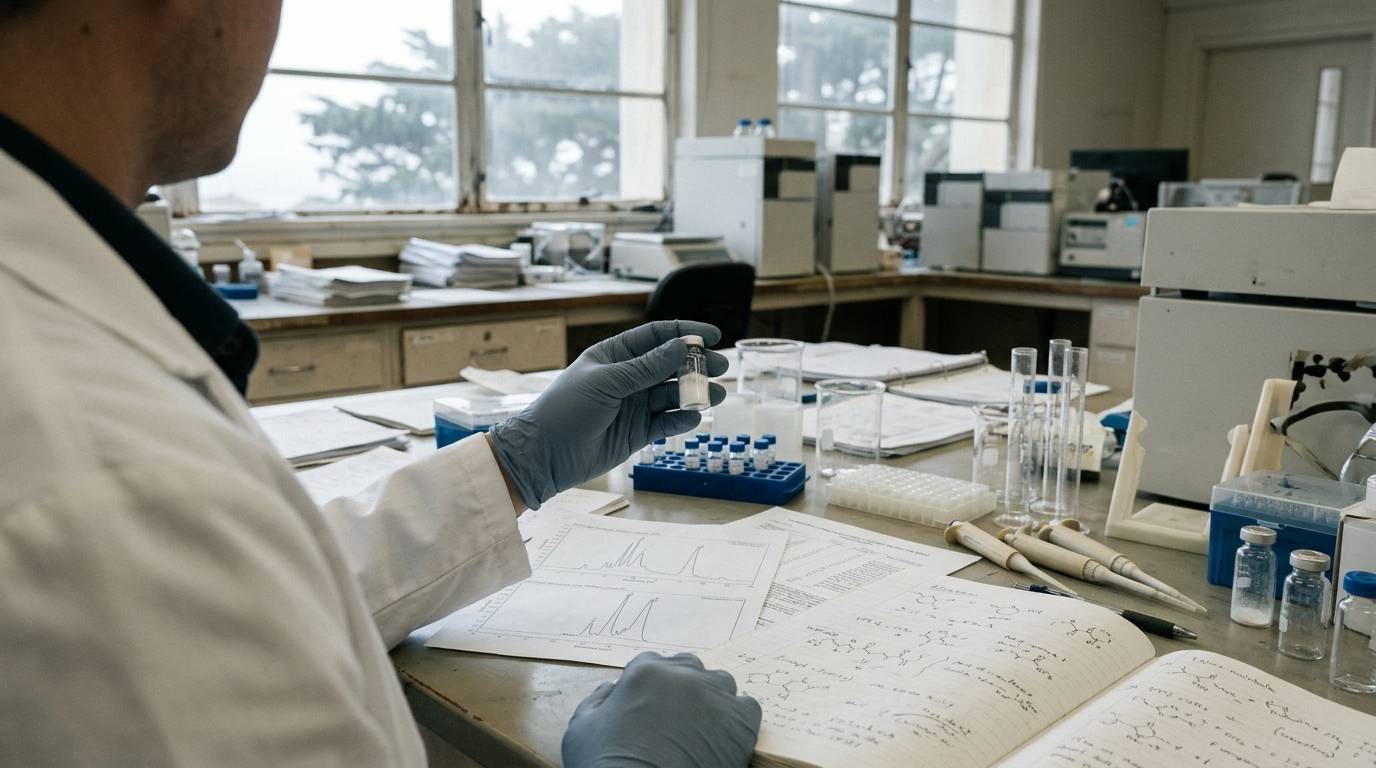
How do laboratories define and measure peptide purity during experimental procedures? Researchers routinely review analytical reports to understand the composition of a specific sample. The scientific question under examination is how chromatographic methods and regulatory guidelines construct this metric. We must evaluate whether a purity percentage represents a universal mass measurement or a method-dependent result.
The available evidence for these analytical standards rests on official regulatory frameworks and in vitro laboratory models. A recent in vitro study utilizing a synthetic peptide impurity library examined the mechanics of peptide purification. Additionally, official regulatory guidance from ICH Q2(R2) dictates the validation considerations for analytical procedures. These documents establish strict technical definitions for laboratory testing. They apply solely to laboratory material specifications, and they never imply human benefit, safety, or clinical efficacy.
What Is The Established Regulatory Framework?
The established scientific understanding organizes laboratory testing into distinct analytical categories. The applicable official guidance is ICH Q2(R2). This guidance describes validation considerations for analytical procedures used for specific laboratory purposes. The common purposes outlined by the guideline include assay/potency, purity, impurities, and identity measurements.
A critical component of this regulatory framework is the strict separation of these testing categories. ICH Q2(R2) covers analytical procedures for these distinct purposes and treats them as separate analytical objectives. Validation is framed entirely around the intended purpose of the specific procedure. A procedure validated to measure peptide purity is distinct from one designed to confirm compound identity or sequence. Researchers must interpret analytical reports with these specific boundaries in mind.
How Is Peptide Purity Measured In Practice?
Original laboratory experiments illustrate exactly how these complex testing procedures function in practice. In the referenced peptide study, researchers utilized an in vitro synthetic peptide impurity library to evaluate separation techniques. Within this specific model, purity was determined by LC-UV area normalization. This specific technique calculates the relative response of the primary substance against the total detector response.
The accuracy and relevance of this determination depend entirely on the physical testing conditions. The documented analytical procedure specified highly controlled parameters to achieve chemical separation. It required a C18 column and a specific 214-nm UV wavelength. The procedure also utilized a steady 1.0 mL/min flow rate alongside a particular gradient.
During the purification process, fractions were collected in a highly targeted manner. This collection was based directly on the UV signal at 214 nm, using a precise fraction volume of 15 mL for each collection.
Why Are The Analytical Limits So Important?
The evidence demonstrates that a purity percentage is not an absolute confirmation of overall quality. It is a highly specific interpretation constrained by the chosen methodology. The LC-UV area normalization relies exclusively on the detector response at the 214-nm UV wavelength. If a compound or degradation product does not absorb light strongly at that specific wavelength, it will not appear in the final area normalization calculation.
Furthermore, changing any physical parameter will alter the final calculation. Modifying the C18 column or adjusting the flow rate changes how molecules separate during testing. Therefore, a reported purity percentage applies only to the tested sample and the exact reported methods. Reading a laboratory record requires understanding that a certificate of analysis documents a specific test condition. It does not serve as a generalized guarantee of material perfection.
Where Do These Analytical Standards Originate?
All scientific claims regarding peptide analysis must remain firmly grounded in original laboratory documentation. The specific parameters for the C18 column, the flow rate, and the fraction volumes originate from the referenced in vitro research. Meanwhile, the clear separation of assay, purity, and identity stems directly from the ICH Q2(R2) official guidance.
Together, these sources clearly define the boundaries of what different study models demonstrate. They confirm that analytical procedures answer strictly defined laboratory questions. If the original support for an alternative testing method is absent, researchers must rely on the established ICH Q2(R2) definitions.
To conclude, researchers should actively verify the testing parameters on any laboratory document. As an actionable step today, look for the specific UV wavelength and column type listed next to the purity percentage on your documentation. This simple check ensures you understand exactly how the laboratory determined the reported metric.
Sources
Introducing / CaliLean Field Notes
A little more
perspective.
An editorial letter for curious minds. Thoughtful reading, questions worth keeping and the sources behind them.
Explore Field Notes Join the list for the first edition