When reviewing laboratory documentation for research peptides, a high purity percentage is often misinterpreted as a complete account of a compound. The scientific question remains whether a single metric can verify a peptide's identity, biological activity, and total mass. Researchers often hypothesize that a high percentage on a report guarantees an absence of meaningful impurities. However, analytical science demonstrates that this percentage merely describes the signal under a specific set of testing conditions.
How Do Study Models Define Peptide Purity?
We can examine this concept through a recent in vitro study published in February 2026. Researchers evaluated a synthetic peptide impurity library to understand how analytical methods perform. The study used 23 synthetic peptides as nonbioactive model scaffolds, including five targets and deliberately synthesized impurities. Because these were nonbioactive model scaffolds, the results demonstrate analytical method behavior rather than therapeutic validation.
What Do Standard Chromatographic Methods Actually Detect?
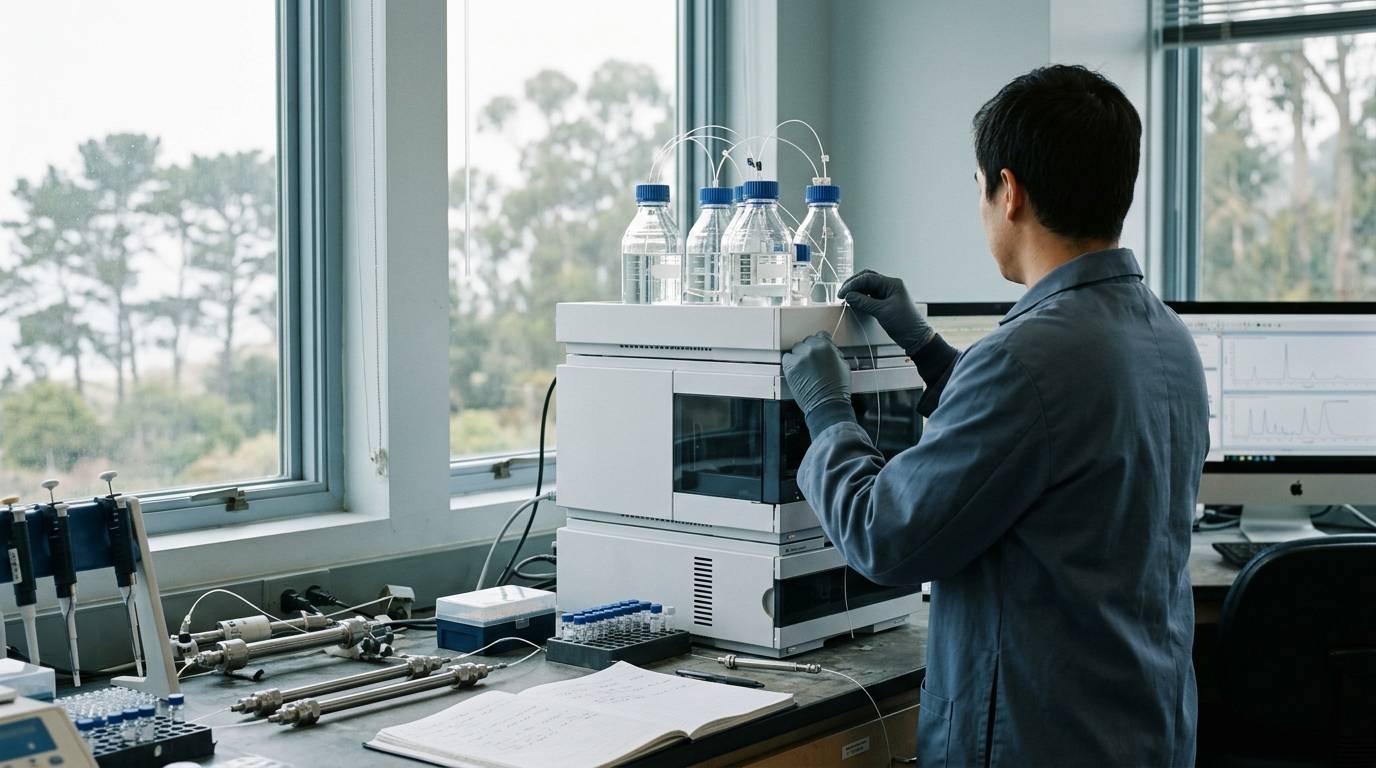
In standard laboratory practice, purity is frequently determined by liquid chromatography paired with ultraviolet detection. This technique is known as LC-UV area normalization. The reference method in the recent study utilized a C18 column and measured the peptide signal at 214 nm. The researchers used a highly specific solvent gradient over a 65-minute run time to separate the compounds.
This process began with a five-minute phase at five percent solvent concentration. The gradient then increased to 95 percent concentration over the next 45 minutes. Following this phase, the system re-equilibrated to prepare for subsequent testing. The flow rate was maintained at 1.0 mL per minute, and the column temperature was strictly set to 30°C.
Under these precise parameters, the final purity percentage reflects only what the ultraviolet detector can see and separate during that exact gradient. Changing the flow rate, the column temperature, or the gradient timeline could yield an entirely different purity calculation. This dependency on testing conditions demonstrates why peptide identity and purity testing relies heavily on documented method parameters. Researchers must evaluate the analytical protocol alongside the final score.
Why Are Purity and Identity Separate Analytical Questions?
A common error in research environments is assuming that high purity confirms correct molecular identity. The 2026 study explicitly separated these tasks to maintain rigorous standards. The researchers used LC-UV area normalization strictly for purity determination. Conversely, they employed liquid chromatography mass spectrometry (LC-MS) exclusively to confirm the identity of the peptides.
Total material content is yet another distinct measurement. The study separated physical mass measurement from both purity and identity testing. Researchers calculated recovery gravimetrically after lyophilization. They did this by comparing the mass of the collected fraction to the initial mass loaded onto the cartridge.
Treating these three metrics as separate questions is fundamental for researchers seeking to evaluate peptide laboratory evidence. A compound can have high signal purity while lacking the correct molecular mass.
Can Mass Spectrometry Alone Measure Purity?
The study highlights significant limitations when relying on mass spectrometry without adequate chromatographic separation. The synthetic impurity library contained seven impurity groups. These included leucine and isoleucine isomers, isoaspartate formation, and deamidation variants. The authors cautioned that deamidated species and isoaspartate variants can have identical or near-identical masses to the target peptide.
Because these impurities share near-identical masses, they cannot be distinguished by mass alone. Therefore, mass spectrometry is insufficient for purity assessment if the chromatographic resolution cannot physically separate these structurally similar variants. If the LC-UV method fails to separate an isomer, the mass spectrometer will simply confirm the mass of the blended signal. This reinforces why robust chromatographic methods must precede mass analysis.
Where Does the Laboratory Evidence Originate?
The findings discussed here are drawn directly from the February 2026 study on peptide purification. This research was published under the identifier PMC12890753. The original in vitro experiments establish the boundaries of what LC-UV and LC-MS methods can actually confirm. By relying on primary literature, peptide researchers can better interpret the limitations of standard analytical reports.
Recognizing the specific parameters of these methods ensures that laboratory documentation is not overstated. Accurate interpretation requires reading the method details rather than just the final summarized numbers.
Takeaway: When evaluating a peptide Certificate of Analysis, read the specific chromatographic conditions to ensure the method can actually resolve closely related impurities.
Sources
Introducing / CaliLean Field Notes
A little more
perspective.
An editorial letter for curious minds. Thoughtful reading, questions worth keeping and the sources behind them.
Explore Field Notes Join the list for the first edition