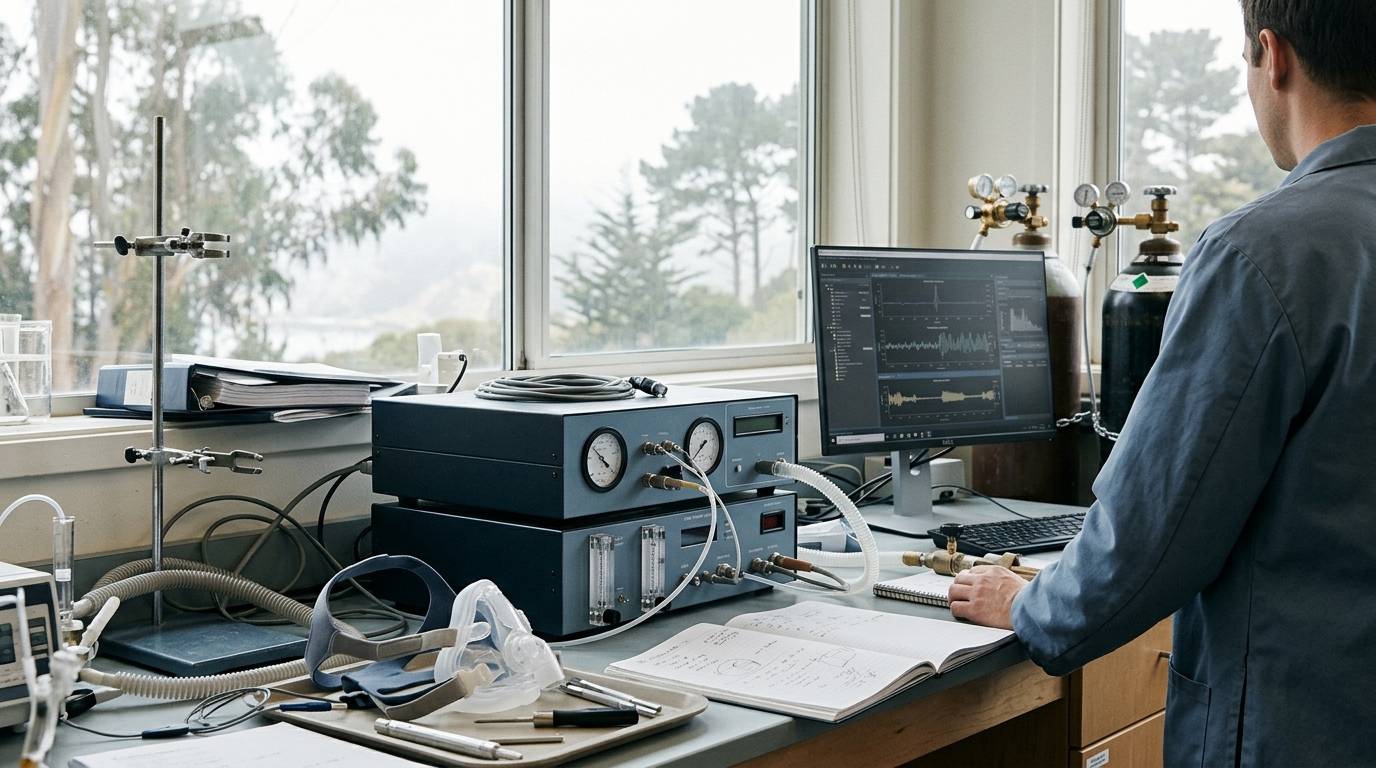
Indirect calorimetry is a laboratory technique that evaluates metabolic rate by measuring respiratory gas exchange. It is not a direct measurement of thermal heat dissipation from an organism. Instead, it quantifies oxygen consumption and carbon dioxide production to model whole-body energy expenditure and substrate utilization. Researchers evaluating literature in metabolism and energy research must understand the operational principles, core mathematical derivations, and technical confounders that govern these systems.
This guide examines the core calculations behind respiratory gas exchange, the experimental animal models utilized, and the variables that introduce variance across metabolic trials.
What Does Indirect Calorimetry Actually Measure?
Indirect calorimetry calculates metabolic rate indirectly through respiratory exchange. In small animal research, subjects are housed in specialized chambers where gas concentrations are continuously monitored. Sensors record the volume of oxygen consumed, known as VO₂, alongside the volume of carbon dioxide produced, designated as VCO₂.
Energy expenditure is subsequently calculated from these gas exchange values using empirical formulas, such as the Weir equation. Because it derives values from consumed oxygen and expired carbon dioxide, the resulting energy expenditure is an estimate rather than a direct measurement of physical heat production. Direct calorimetry, by contrast, physically quantifies the heat emitted by the organism within an enclosed thermal environment.
The relationship between carbon dioxide production and oxygen consumption provides insight into the type of fuel being oxidized. The respiratory exchange ratio, or RER, is calculated by dividing VCO₂ by VO₂. A study examining C57BL/6J male mice documented this calculation directly to monitor substrate oxidation shifts over time.
Many automated animal calorimetry systems also capture concurrent physiological and behavioral data. Research across diverse mouse cohorts, including C57BL/6J, 129, and genetically altered strains, shows that modern setups incorporate infrared beam breaks to assess physical movement alongside automated floor feeders to track food intake. Combining behavioral tracking with respiratory gases helps investigators distinguish changes in baseline metabolic rate from shifts in physical activity or feeding patterns.
What Study Models Support Indirect Calorimetry Research?
The operational standards and validation studies for indirect calorimetry rely heavily on rodent models. Published methodologies predominantly evaluate laboratory mice and rats under strictly regulated laboratory environments. Strains commonly documented in preclinical gas-exchange studies include wild-type C57BL/6J mice, 129 strain mice, diet-induced obesity models, and targeted knockout lines.
Because these studies assess small quadruped rodents, translational assumptions require caution. When analyzing preclinical peptide literature, researchers must remember the distance between experimental models and human physiology. Rodents possess distinct surface-area-to-mass ratios, non-shivering thermogenic capacities, and metabolic rates that differ substantially from larger mammals.
Furthermore, evidence collected from mouse respirometry systems does not constitute controlled human clinical evidence. Preclinical models highlight physiological mechanisms under controlled ambient parameters. These findings cannot be treated as clinical proof of efficacy, human safety, or clinical application.
How Do Experimental Conditions Alter Metabolic Readouts?
External environmental factors strongly influence gas exchange and energy expenditure measurements. A central source of variation across metabolic laboratories is the duration of the pre-recording acclimation phase. Placing an animal into a novel testing chamber induces acute behavioral and autonomic stress responses.
To minimize stress-related artifacts, investigators introduce an equilibration interval before active data acquisition begins. For example, a published mouse protocol evaluating fasting metabolism requires at least 48 hours of chamber equilibration before data recording. This 48-hour period represents a protocol-specific experimental choice for that defined fasting design. It does not establish a universal rule that every metabolic study requires that exact timeframe.
Ambient testing temperature also heavily modifies metabolic outcomes in rodent housing systems. A methodological review evaluating laboratory mice and rats emphasized that baseline energy expenditure must be decoupled from cold-induced thermogenesis. Standard laboratory housing temperatures typically sit below the thermoneutral zone for rodents, forcing animals to expend energy simply maintaining core body temperature.
The same methodological review recommends that researchers employ specific controls to isolate basal metabolic rate from confounding variables. These recommendations include:
- Setting housing chambers to thermoneutral conditions to prevent cold-induced metabolic compensation.
- Strictly controlling food access to isolate basal expenditure from the thermic effect of feeding.
- Measuring physical activity precisely to separate locomotor expenditure from resting metabolism.
- Collecting data at high sampling frequencies to capture rapid shifts in respiratory dynamics.
Without these specific experimental controls, changes attributed to experimental interventions may simply reflect spontaneous movement, altered feeding intervals, or thermal stress. When evaluating metabolic studies, researchers must scrutinize experimental peptide study designs to verify whether authors controlled for these systematic confounders.
What Are the Core Methodological Limitations and Unknowns?
Indirect calorimetry relies on underlying assumptions regarding respiratory exchange and fuel utilization. When investigators calculate energy expenditure via empirical formulas, they assume that gas exchange accurately mirrors internal cellular oxidation. Rapid shifts in acid-base balance, hyperventilation, or intense anaerobic exertion can temporarily skew carbon dioxide elimination, distorting the calculated RER.
Another technical limitation involves data normalization choices. Preclinical studies frequently report VO₂ or energy expenditure normalized simply to total body weight. However, fat mass and lean mass consume oxygen at vastly different rates per unit of tissue. Normalizing by total mass without accounting for body composition differences can generate misleading statistical conclusions, particularly in obesity models where body weight varies widely.
Equipment calibration and chamber dynamics present additional sources of experimental error. Differences in chamber flow rates, cage volume, and sensor response times dictate how rapidly a system detects metabolic fluctuations. Laboratories must apply rigorous analytical testing methods to calibrate gas analyzers against verified reference standards to ensure analytical repeatability across testing runs.
Finally, experimental protocol divergence limits direct comparisons between published papers. Variations in photoperiod schedules, acclimation durations, temperature controls, and diet composition alter metabolic outputs. An effect observed under room-temperature conditions with unrestricted feeding may disappear entirely when evaluated at thermoneutrality with controlled meal intervals.
Frequently Asked Questions
Does indirect calorimetry directly measure thermal heat production?
No, it does not directly capture heat dissipation. It measures oxygen consumption and carbon dioxide production via respiratory exchange. Energy expenditure is then mathematically calculated using empirical equations, such as the Weir formula.
Why do experimental protocols use different chamber equilibration times?
Equilibration periods allow animals to adapt to novel chamber environments and novel feeding hardware. While one published fasting protocol specifies an equilibration window of at least 48 hours, that duration was chosen for that specific study. Different research questions, mouse strains, and housing setups may require different acclimation intervals.
Can energy expenditure be interpreted without measuring animal movement?
Interpreting energy expenditure without tracking physical movement introduces significant uncertainty. Locomotor activity consumes energy and alters oxygen consumption. Modern rodent setups typically record movement through infrared beam systems to help researchers differentiate basal metabolic shifts from physical activity.
Does a respiratory exchange ratio indicate total energy expended?
No, the respiratory exchange ratio indicates the ratio of VCO₂ to VO₂. It reflects the relative proportion of carbohydrates and lipids being oxidized by the organism. Absolute energy expenditure requires calculating total gas volumes consumed and produced over time.
Sources
- Flavan-3-ol fraction from cocoa powder promotes ...
- Protocol to evaluate fasting metabolism and its relationship to the ...
- Indirect calorimetry in laboratory mice and rats: principles, practical considerations, interpretation and perspectives - PubMed
- Mouse Thermoregulation: Introducing the Concept of ... - PMC - NIH
- Methods for the Comprehensive in vivo Analysis of Energy ...
Introducing / CaliLean Field Notes
A little more
perspective.
An editorial letter for curious minds. Thoughtful reading, questions worth keeping and the sources behind them.
Explore Field Notes Join the list for the first edition