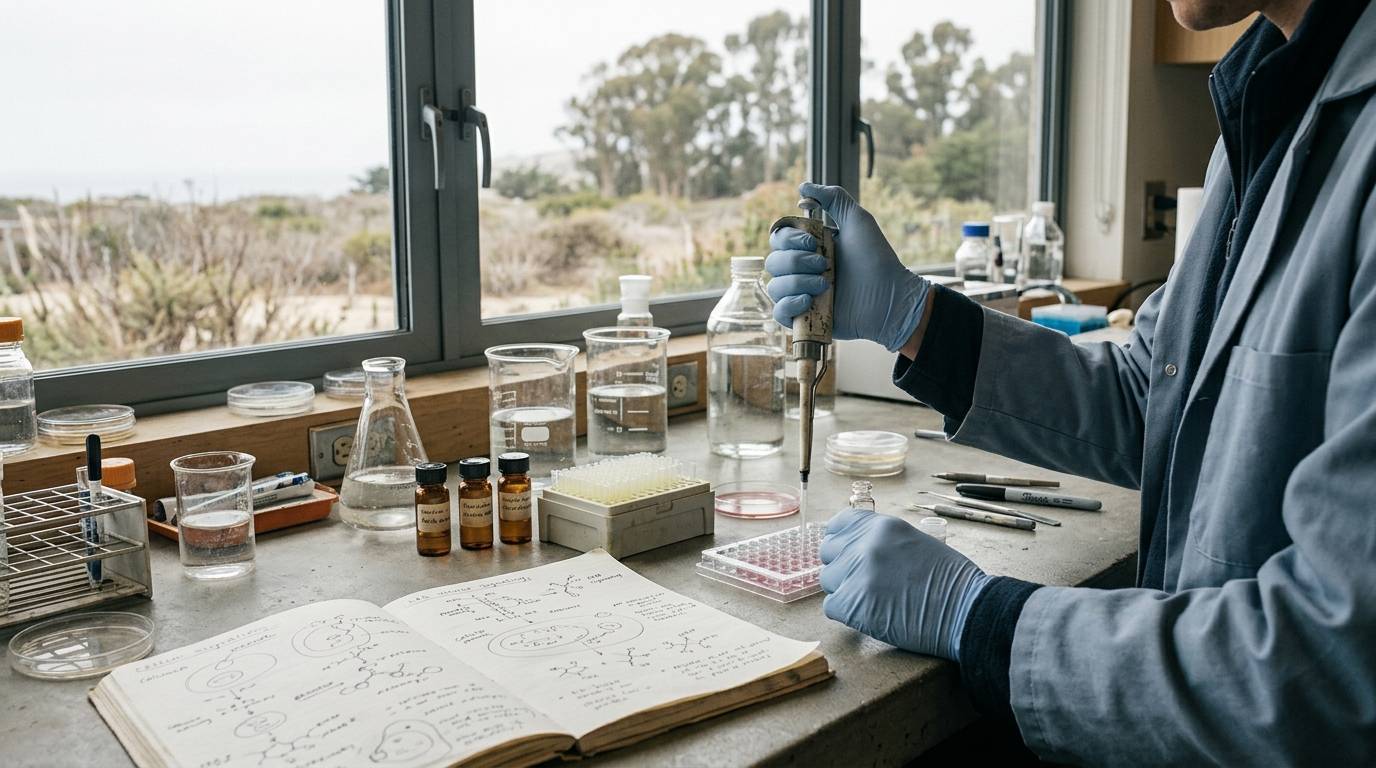
A researcher prepares a low-concentration peptide dilution in a standard microcentrifuge tube. Two hours later, a replicate assay produces a significantly weaker biological signal than expected. The researcher often attributes this drop to synthesis failure or flawed assay reagents. In many cases, physical adsorption to the plastic wall or rapid degradation has drastically altered the nominal concentration of the working solution.
Understanding peptide stability is essential when designing assays or interpreting published findings in recovery, repair and regenerative research. When peptides degrade, aggregate, or adsorb to container surfaces, the actual concentration tested deviates from the planned protocol. This guide examines how laboratory conditions influence peptide integrity, outlines findings from container adsorption models, and details analytical considerations for evaluating experimental documentation.
What affects peptide stability in the laboratory
Peptides are chemically active chains of amino acids that react to their immediate physical and chemical environment. Unlike many small molecules, peptides possess flexible secondary structures and exposed functional groups that make them prone to structural alteration.
Regulatory benchmarks provide a clear framework for identifying environmental vulnerabilities. The International Council for Harmonisation provides stability testing guidance in its ICH Q1 document. According to ICH Q1, environmental and physical factors such as temperature, humidity, light, and agitation directly influence substance quality over time.
Additional regulatory criteria exist specifically for macromolecular compounds. The United States Food and Drug Administration outlines stability considerations for biotechnological and biological products in its ICH Q5C guidance. This document notes that proteins and polypeptides are sensitive to several primary environmental factors:
- Temperature fluctuations during storage and handling
- Oxidation of susceptible residues
- Exposure to ambient light
- Variations in ionic content within the buffer or solvent
- Mechanical shear stress during mixing or transport
These environmental variables can compromise experimental reproducibility if researchers do not account for them. When reviewing published literature, inspecting how investigators handled these physical parameters is an important step when learning how to read research critically.
How container adsorption alters working solutions
Beyond chemical degradation, physical loss of peptide mass presents a persistent challenge in laboratory workflows. Peptides frequently adhere to solid surfaces through electrostatic interactions and hydrophobic binding. This process occurs silently without generating typical degradation peaks on simple chromatographic readouts.
A primary in vitro laboratory study published in PLOS ONE investigated this physical loss mechanism directly. The researchers evaluated three cationic, membrane-active peptides: mastoparan X, melittin, and magainin 2. They used analytical high-performance liquid chromatography to measure peptide recovery across commonly used glass and plastic sample containers.
The experimental findings demonstrated substantial material loss. At typical experimental peptide concentrations, the study authors reported that rapid adsorption to container walls could remove 90% or more of the peptide from solution.
This observation highlights a major source of experimental error in preclinical models. When 90% of the active peptide binds to the container wall, the delivered dose represents a fraction of the intended target. If investigators fail to quantify adsorption, they may incorrectly conclude that a peptide possesses low potency. Conversely, unexpected desorption in later steps can introduce variable concentrations that disrupt experimental controls.
Study models and evidence levels
Evaluating peptide stability literature requires distinguishing between established regulatory guidelines and specific bench experiments. Each data type provides distinct insights with specific boundaries.
The container adsorption findings represent in vitro bench experiments. They apply directly to cationic, membrane-active peptides in specific glass and plastic vessels under defined laboratory conditions. These findings cannot be generalized across all peptide sequences, neutral peptides, or complex biological matrices without direct testing.
In contrast, ICH Q1 and ICH Q5C documents represent regulatory consensus frameworks for stability testing. They define which environmental factors must be controlled and monitored during stability assessments. These guidelines do not describe experimental outcomes for specific repair peptides. Instead, they provide standard testing categories for evaluating temperature changes, oxidation, light, ionic content, and agitation.
Maintaining this distinction prevents overstating preliminary results. When reviewing study protocols according to rigorous research standards, researchers must verify whether stability claims stem from direct quantitative measurements or generalized assumptions.
How analytical testing documents degradation
Documenting stability requires analytical methods capable of separating intact peptides from degradation products and related substances. High-performance liquid chromatography serves as a primary tool for quantifying parent peptide purity and identifying breakdown products.
However, analytical methods have distinct operational limits. A Certificate of Analysis confirms purity and identity only for the specific sample tested at that single point in time. It does not establish how that material will behave once reconstituted in aqueous buffers, exposed to light, or stored in plastic containers.
Relying on a single chromatographic peak can obscure non-chemical losses such as surface adsorption or precipitation. Understanding how to read a peptide certificate of analysis helps investigators recognize what a laboratory document confirms and what it leaves unaddressed. Researchers must evaluate absolute peptide content rather than relying entirely on relative chromatographic peak area percentages. Comprehensive protocols address these parameters by examining peptide identity, purity, and content evidence standards through multiple complementary techniques.
Study limitations and experimental unknowns
Substantial gaps remain in the published literature regarding peptide stability during routine laboratory handling. Preclinical papers frequently omit details concerning container materials, reconstitution buffer ionic strength, and exact handling temperatures.
First, adsorption research has evaluated only a limited subset of peptide structures. While cationic peptides like mastoparan X, melittin, and magainin 2 exhibit extensive wall binding, peptides with neutral or acidic net charges may behave differently. The extent to which specific vessel coatings or low-binding plastics reduce adsorption across diverse sequences remains an open experimental question.
Second, chemical degradation pathways depend heavily on primary sequence. Polypeptides containing methionine, cysteine, tryptophan, or asparagine exhibit distinct vulnerabilities to oxidation or deamidation. A stability profile established for one peptide cannot predict the degradation timeline of another sequence under identical storage conditions.
Finally, standard analytical reports cannot verify post-handling concentration. If a peptide solution experiences significant shear stress or container adsorption after opening, testing records from the bulk material provide no guarantee of the concentration delivered to the assay.
When to revisit this resource
Revisit this resource when designing in vitro dilution protocols, troubleshooting inconsistent assay responses, or auditing storage procedures for synthetic peptides.
Maintaining control over physical handling, container selection, and environmental variables remains critical for producing reproducible peptide research.
Sources
Introducing / CaliLean Field Notes
A little more
perspective.
An editorial letter for curious minds. Thoughtful reading, questions worth keeping and the sources behind them.
Explore Field Notes Join the list for the first edition