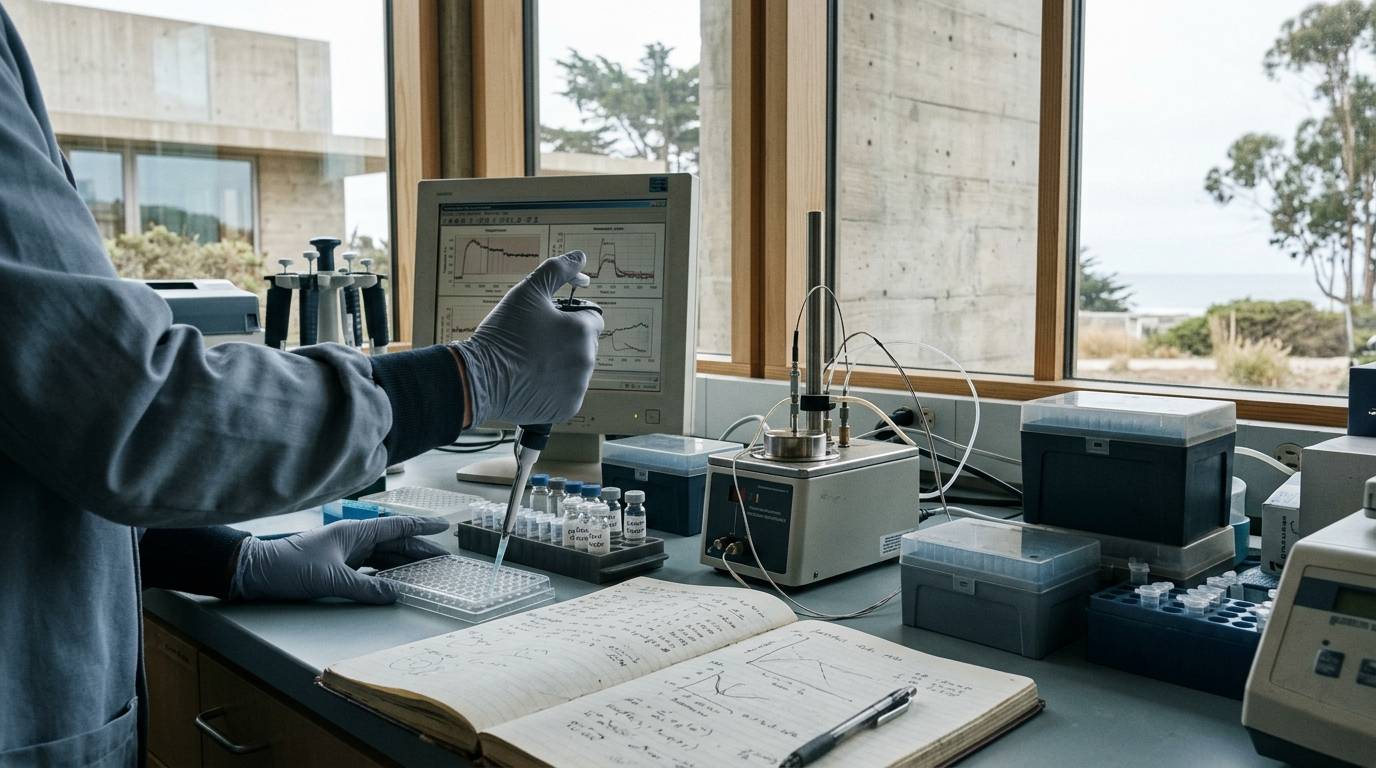
Many researchers assume that peptide signaling pathways linked to weight loss must stimulate metabolic rate and increase thermogenesis. Rigorous clinical indirect calorimetry reveals that peripheral peptide exposure can produce the exact opposite outcome. Thermogenesis refers to heat production in biological organisms, often categorized into basal thermogenesis, cold-induced thermogenesis, and diet-induced thermogenesis. Diet-induced thermogenesis represents the increase in energy expenditure above basal levels following meal ingestion, driven by the metabolic cost of processing nutrients.
This resource examines how peptide administration influences energy expenditure and heat production in controlled environments. Specifically, it reviews controlled human evidence regarding peripheral glucagon-like peptide-1 (GLP-1) infusion and its direct impact on postprandial metabolic rate.
Question Assumptions About Peptide-Driven Heat Production
Weight regulation involves a balance between energy intake, energy absorption, and energy expenditure. Because incretin peptides alter metabolic outcomes, laboratory hypotheses often presume that these signaling molecules elevate energy expenditure directly.
Human metabolic chambers and ventilated hood systems provide precise physical metrics of gas exchange. When investigators assess real-time substrate oxidation, peripheral signaling does not always accelerate metabolic burning. Instead, systemic regulatory effects on the gastrointestinal tract can suppress acute heat production after a meal. Understanding these nuances requires distinguishing whole-body caloric expenditure from isolated tissue signaling. Researchers must avoid projecting systemic metabolic increases onto compounds whose primary clinical effect involves altered nutrient delivery.
Distinguish Clinical Measurement from Preclinical Theory
Metabolic research relies on different experimental layers to evaluate energy expenditure. Cell culture models can isolate uncoupling proteins in adipocytes, yet they lack intact neural circuits, vascular perfusion, and digestive feedback loops. Animal studies often assess energy expenditure in rodents housed at room temperature, which induces cold stress and can exaggerate thermogenic responses.
Controlled human trials serve as the benchmark for verifying whole-body metabolic changes. Researchers can review the hierarchy of evidence levels to assess how data shifts between isolated models and human physiology. When moving from bench assays to whole-body human physiology, systemic effects frequently override cellular predictions. For this reason, controlled human trials provide the highest evidentiary weight when determining whether a peptide increases or decreases diet-induced thermogenesis.
Examine Controlled Human Calorimetry Data
The primary human evidence evaluating acute peripheral GLP-1 administration and diet-induced thermogenesis comes from a randomized, blinded, placebo-controlled crossover study. Investigators designed the trial to measure whole-body gas exchange under standardized dietary conditions.
The study enrolled 20 healthy, normal-weight men between 20 and 31 years of age. Participants had a body mass index ranging from 20.3 to 25.7 kg/m². Restricting the cohort to normal-weight young adult males minimized confounding variables from metabolic dysregulation, insulin resistance, or age-related declines in energy expenditure.
Investigators administered a continuous peripheral infusion of GLP-1 at a rate of 50 pmol/kg per hour or an equivalent saline infusion. The infusion began simultaneously with the consumption of a standardized test breakfast. The meal provided 20 percent of each participant's calculated daily energy requirement. The macronutrient distribution consisted of 50 percent carbohydrates, 37 percent fat, and 13 percent protein.
To track metabolic responses, researchers measured energy expenditure and substrate oxidation rates continuously before the meal and for four hours afterward. Measurements were obtained using a ventilated hood system, an established technique for open-circuit indirect calorimetry.
Trace Metabolic Findings and Delayed Absorption Pathways
The trial demonstrated that acute peripheral GLP-1 infusion significantly altered postprandial energetics compared to placebo. Rather than stimulating energy expenditure, peripheral GLP-1 decreased diet-induced thermogenesis over the four-hour observation window. Furthermore, the infusion suppressed carbohydrate oxidation rates during this period.
To explain these findings, the study authors examined corresponding endocrine and circulating substrate markers. The authors suggested delayed nutrient absorption as a probable explanation for the reduction in diet-induced thermogenesis. During the GLP-1 infusion, plasma concentrations of circulating substrates and metabolic hormones were notably suppressed. When examining cellular mechanisms and signaling pathways, researchers must note that GLP-1 is a potent inhibitor of gastric emptying.
Delayed gastric emptying slows the entry of glucose and amino acids into the small intestine. This deceleration reduces the rapid surge of nutrients into systemic circulation. Because diet-induced thermogenesis reflects the energetic work of absorbing, processing, and storing incoming macronutrients, slowing nutrient entry naturally spreads the thermic response over a longer timeline. As discussed in guides on interpreting peptide research papers, suppressing acute heat production over a four-hour window does not imply long-term metabolic dysfunction. Instead, it reflects altered gastrointestinal transit kinetics.
Address Methodological Boundaries and Missing Data
Every indirect calorimetry study possesses distinct boundaries that define the reach of its conclusions. First, the 2000 crossover trial evaluated a specific cohort of 20 healthy, young, normal-weight males. These findings cannot be generalized to female subjects, older populations, or individuals with obesity and type 2 diabetes without direct confirmatory trials.
Second, the observation window was limited to four hours postprandium. A four-hour measurement period captures acute postprandial responses, but it cannot determine whether total diet-induced thermogenesis was genuinely reduced or simply displaced past the four-hour mark. If nutrient absorption was merely delayed, indirect calorimetry extended across six or eight hours might detect a prolonged, low-amplitude thermic effect.
Third, the route of delivery presents an experimental constraint. A continuous peripheral intravenous infusion at 50 pmol/kg per hour creates steady-state plasma concentrations that differ from endogenous pulsatile secretion. Finally, researchers must separate acute single-meal responses from chronic multi-week exposures. The acute reduction in postprandial energy expenditure observed in this human trial does not establish how sustained signaling influences resting metabolic rate over months. When evaluating experimental models, scientists must treat acute calorimetry data as a measure of postprandial kinetics rather than a permanent downregulation of metabolic capacity.
Review Key Takeaways
- Peripheral GLP-1 infusion in healthy human males reduces acute diet-induced thermogenesis rather than increasing it.
- In a randomized, blinded crossover trial of 20 normal-weight men, GLP-1 suppressed postprandial carbohydrate oxidation over a four-hour window.
- The likely mechanism underlying reduced postprandial heat production is delayed nutrient absorption caused by decelerated gastric emptying.
- Indirect calorimetry over four hours captures immediate metabolic transit but cannot resolve whether overall caloric processing is diminished or merely deferred.
- Translational claims assuming all metabolic peptides accelerate thermogenic burning are directly contradicted by controlled human indirect calorimetry data.
Calorimetric evidence demonstrates that peptide-induced changes in postprandial heat production stem from complex digestive kinetics rather than simple cellular activation.
Sources
Introducing / CaliLean Field Notes
A little more
perspective.
An editorial letter for curious minds. Thoughtful reading, questions worth keeping and the sources behind them.
Explore Field Notes Join the list for the first edition