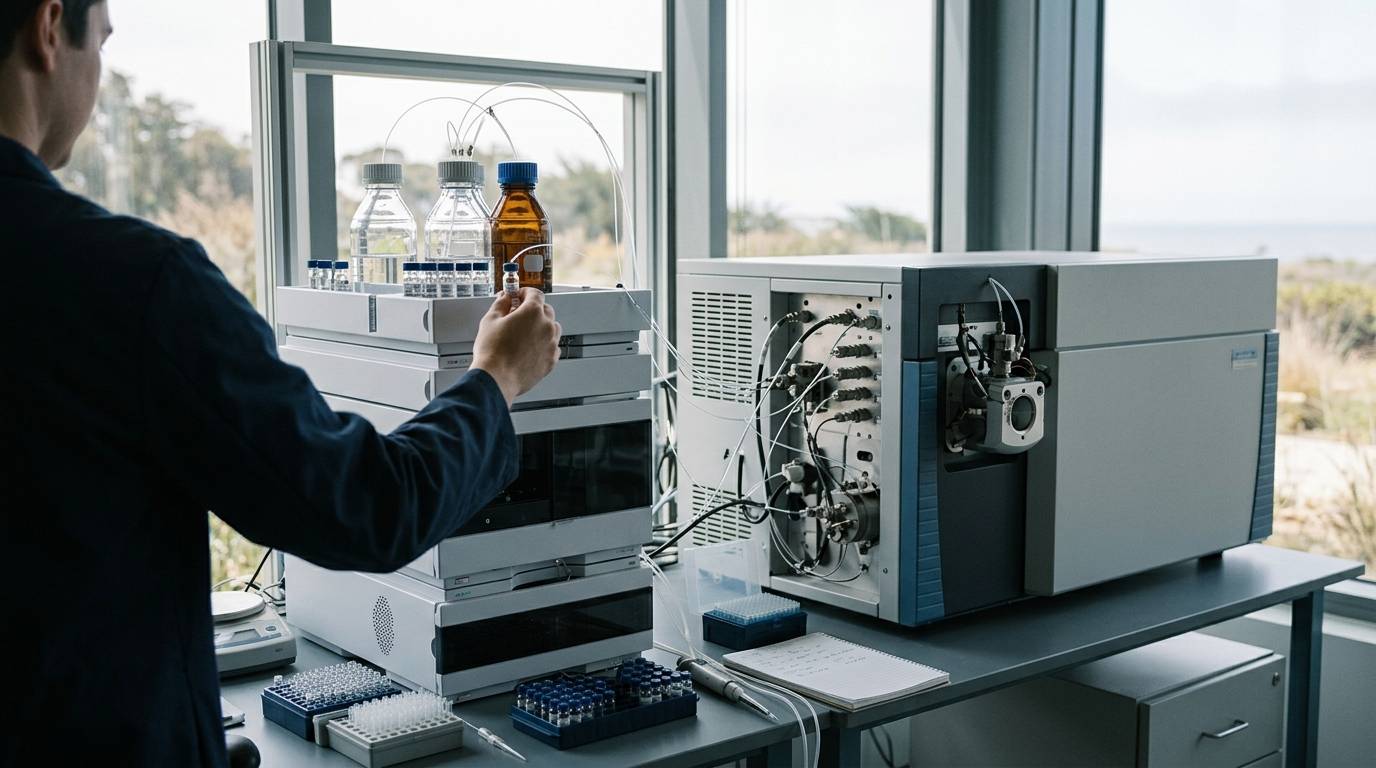
Determining the exact composition of a laboratory sample requires multiple analytical approaches. A frequent scientific question is how experimental laboratories separate a target compound from closely related synthesis impurities. Researchers often rely on high-performance liquid chromatography and mass spectrometry. However, each instrument answers a distinctly different question about the sample.
Recent literature clarifies the boundaries of these analytical tools. An in vitro method-development study investigated these capabilities using a synthetic peptide impurity library. The model included 23 nonbioactive synthetic species. The researchers tested chromatographic separation and peptide-purity measurement against common synthesis impurities, such as deamidation and isomerisation products.
Regulatory Guidelines Define Analytical Roles
Standardized frameworks structure how analytical data should be interpreted. The ICH Q2(R2) document is the official guidance on the validation of analytical procedures. Its scope covers new or revised procedures used for release and stability testing of commercial drug substances and products.
This official guidance identifies several common analytical purposes. These include assay or potency, purity, impurities, and identity. A single test rarely satisfies all these distinct qualitative and quantitative requirements. Understanding this regulatory distinction helps clarify why multiple testing methods are necessary in laboratory environments.
Mass Identifies While Chromatography Separates
The in vitro study of the 23-peptide library clearly demonstrated the division of labor between laboratory instruments. The authors used liquid chromatography with ultraviolet detection for their initial purity assessment. Conversely, they employed a dedicated liquid chromatography mass spectrometry method exclusively for identity confirmation.
Relying on mass alone presents a significant analytical blind spot. The study noted that deamidated and isoaspartate-related variants can share identical or near-identical masses with the target peptide. Because the masses are so similar, mass spectrometry alone cannot distinguish the target from the variant. Mass spectrometry remains insufficient for purity assessment without adequate chromatographic resolution preceding it.
This limitation highlights the importance of thorough separation techniques. When laboratories evaluate what peptide purity actually measures, they are fundamentally examining this physical separation. If the chromatography fails to resolve the components, identical masses will blend into a single misleading signal.
Gradients and Resolution Control Purity Data
To evaluate separation efficiency, the researchers examined specific chromatographic performance metrics. They assessed whether related peptide species appeared as individual, complete chromatographic peaks. They also measured the number of theoretical plates alongside the overall chromatographic resolution.
The in vitro findings showed that changing the chromatographic conditions severely impacted the resulting separation. Across all tested columns, increasing the gradient steepness to 5 or 10 percent acetonitrile per minute substantially reduced separation quality. This loss of efficiency resulted in an unsatisfactory purity determination for the synthetic mixtures.
Furthermore, the researchers found that the effects of mobile-phase modifiers depended heavily on the specific column and the peptide group. While this model study provides valuable data on separation mechanics, the authors do not report that these methods were validated under ICH Q2(R2) standards. The findings serve to inform laboratory method development rather than establishing clinical or regulatory validation.
Analytical Clarity Demands Multiple Assays
Accurate laboratory characterization relies on acknowledging what an instrument cannot see. Whether studying basic sequences or complex natural peptides, analogues, and peptidomimetics, researchers must separate compounds before they can identify them. A high-resolution mass spectrometer cannot salvage poorly executed chromatography.
The scientific literature shows that distinguishing a peptide from its synthesis impurities requires precise gradient control and distinct analytical methods. An identity confirmation confirms the presence of the intended mass, but it does not quantify related variants. True analytical transparency emerges only when separation and identification act together, leaving no impurities hidden in the margins.
How CaliLean helps
The difficulty of separating scientific evidence from peptide-market hype often occurs when testing documentation omits study limitations. CaliLean solves this problem by pairing research materials with transparent laboratory documentation and clear scientific education. A researcher or technically literate investigator can access these traceable sources to distinguish actual experimental evidence from generalized health claims. Explore the Research Library
Sources
Introducing / CaliLean Field Notes
A little more
perspective.
An editorial letter for curious minds. Thoughtful reading, questions worth keeping and the sources behind them.
Explore Field Notes Join the list for the first edition